Necessary cookies keep Standard Guitar working. With your permission, we also use cookies to remember the chords you save without an account, to measure how the site is used, and for Google's advertising features. You can change your choice at any time with the cookie button in the corner of the page. Privacy policy
NecessaryAlways on
Needed for basic functions such as security, language and logging in. These can't be switched off.
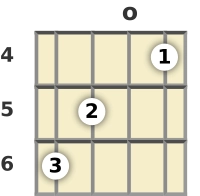
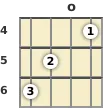
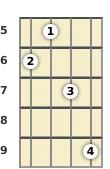
your first finger goes on the fourth fret of the first string
your second finger goes on the fifth fret of the third string
your third finger goes on the sixth fret of the fourth string
the second string is open
Notes in an A♭ 7th, Sharp 9th Banjo chord
Root : A♭
3rd : C
5th : E♭
Flat 7th : G♭
Sharp 9th : B
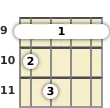
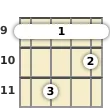
A♭7#9
A♭7#9/C
A♭7#9/B
A♭7#9
Dominant seventh sharp ninth chord
In music, the dominant 7♯9 chord ("dominant seven sharp nine" or "dominant seven sharp ninth") is a chord built by combining a dominant seventh, which includes a major third above the root, with an augmented second, which is the same note, albeit given a different note name, as the minor third degree above the root. This chord is used in many forms of contemporary popular music, including jazz, funk, R&B, rock and pop. As a dominant chord in diatonic harmony, it most commonly functions as a turnaround chord, returning to the tonic.
The chord is also sometimes colloquially known, among pop and rock guitarists, as the "Hendrix chord" or "Purple Haze chord", nicknamed for guitarist Jimi Hendrix, who showed a preference for the chord and did a great deal to popularize its use in mainstream rock music. When used by The Beatles it has been called the "Gretty chord" although this can refer to a distinct six-string version.