Necessary cookies keep Standard Guitar working. With your permission, we also use cookies to remember the chords you save without an account, to measure how the site is used, and for Google's advertising features. You can change your choice at any time with the cookie button in the corner of the page. Privacy policy
NecessaryAlways on
Needed for basic functions such as security, language and logging in. These can't be switched off.
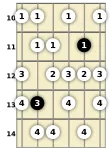
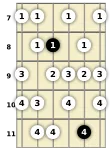
start by assigning your fingers to the eleventh, twelfth, thirteenth and fourteenth frets
on the fifth string play an A sharp on the thirteenth fret using your third finger and a B on the fourteenth fret using your fourth finger
on the fourth string play a C sharp on the eleventh fret using your first finger, a D on the twelfth fret using your second finger and an E on the fourteenth fret using your fourth finger
shift your hand down one fret and on the third string play an F on the tenth fret using your first finger, a G on the twelfth fret using your third finger and a G sharp on the thirteenth fret using your fourth finger
on the second string play an A sharp on the eleventh fret using your second finger
A# Half-Whole DiminishedCAGED Scale Shapes
C Shape
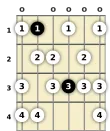
A Shape
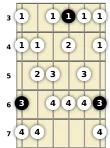
G Shape
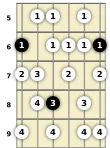
E Shape
D Shape
Recommended Chords for an A# Half-Whole Diminished Scale
An octatonic scale is any eight-note musical scale. However, the term most often refers to the symmetric scale composed of alternating whole and half steps, as shown at right. In classical theory (in contrast to jazz theory), this scale is commonly called the octatonic scale (or the octatonic collection), although there are a total of 42 enharmonically non-equivalent, transpositionally non-equivalent eight-note sets.