Necessary cookies keep Standard Guitar working. With your permission, we also use cookies to remember the chords you save without an account, to measure how the site is used, and for Google's advertising features. You can change your choice at any time with the cookie button in the corner of the page. Privacy policy
NecessaryAlways on
Needed for basic functions such as security, language and logging in. These can't be switched off.
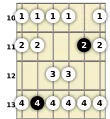
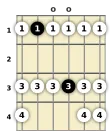
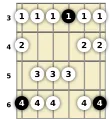
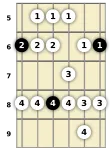
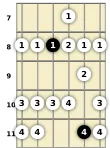
start by assigning your fingers to the tenth, eleventh, twelfth and thirteenth frets
on the fifth string play a B flat on the thirteenth fret using your fourth finger
on the fourth string play a C on the tenth fret using your first finger, a D on the twelfth fret using your third finger and an E flat on the thirteenth fret using your fourth finger
on the third string play an F on the tenth fret using your first finger, a G on the twelfth fret using your third finger and an A flat on the thirteenth fret using your fourth finger
on the second string play a B flat on the eleventh fret using your second finger
Mixolydian mode may refer to one of three things: the name applied to one of the ancient Greek harmoniai or tonoi, based on a particular octave species or scale; one of the medieval church modes; or a modern musical mode or diatonic scale, related to the medieval mode. (The Hypomixolydian mode of medieval music, by contrast, has no modern counterpart.)
The modern diatonic mode is the scale forming the basis of both the rising and falling forms of Harikambhoji in Carnatic music, the classical music form of southern India.