Necessary cookies keep Standard Guitar working. With your permission, we also use cookies to remember the chords you save without an account, to measure how the site is used, and for Google's advertising features. You can change your choice at any time with the cookie button in the corner of the page. Privacy policy
NecessaryAlways on
Needed for basic functions such as security, language and logging in. These can't be switched off.
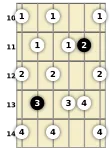
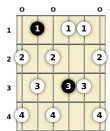
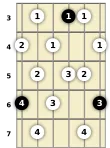
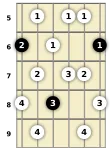
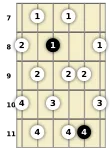
start by assigning your fingers to the tenth, eleventh, twelfth and thirteenth frets
on the fifth string play a B flat on the thirteenth fret using your fourth finger
on the fourth string play a C on the tenth fret using your first finger, then shift your hand up one fret to play a D on the twelfth fret using your second finger and an E on the fourteenth fret using your fourth finger
on the third string play a G flat on the eleventh fret using your first finger and an A flat on the thirteenth fret using your third finger
shift your hand down one fret and on the second string play a B flat on the eleventh fret using your second finger
In music, a whole-tone scale is a scale in which each note is separated from its neighbors by the interval of a whole tone. In twelve-tone equal temperament, there are only two complementary whole-tone scales, both six-note or hexatonic scales. A single whole-tone scale can also be thought of as a "six-tone equal temperament."