Necessary cookies keep Standard Guitar working. With your permission, we also use cookies to remember the chords you save without an account, to measure how the site is used, and for Google's advertising features. You can change your choice at any time with the cookie button in the corner of the page. Privacy policy
NecessaryAlways on
Needed for basic functions such as security, language and logging in. These can't be switched off.
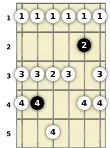
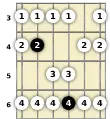
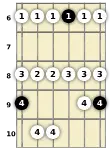
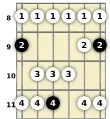
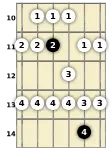
start by assigning your fingers to the first, second, third and fourth frets
on the fifth string play a D flat on the fourth fret using your fourth finger
on the fourth string play an E flat on the first fret using your first finger, then shift your hand up one fret to play an F on the third fret using your second finger and a G on the fifth fret using your fourth finger
shift your hand down one fret and on the third string play an A flat on the first fret using your first finger and a B flat on the third fret using your third finger
on the second string play a C on the first fret using your first finger and a D flat on the second fret using your second finger
The modern Lydian mode is a seven-tone musical scale formed from a rising pattern of pitches comprising three whole tones, a semitone, two more whole tones, and a final semitone.
Because of the importance of the major scale in modern music, the Lydian mode is often described as the scale that begins on the fourth scale degree of the major scale, or alternatively, as the major scale with the fourth scale degree raised half a step. This sequence of pitches roughly describes the scale underlying the fifth of the eight Gregorian (church) modes, known as Mode V or the authentic mode on F, theoretically using B♮ but in practice more commonly featuring B♭. The use of the B♭ as opposed to B♮ would have made such piece in the modern day F major scale.