Necessary cookies keep Standard Guitar working. With your permission, we also use cookies to remember the chords you save without an account, to measure how the site is used, and for Google's advertising features. You can change your choice at any time with the cookie button in the corner of the page. Privacy policy
NecessaryAlways on
Needed for basic functions such as security, language and logging in. These can't be switched off.
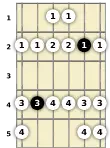
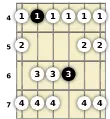
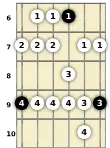
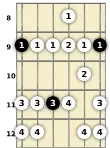
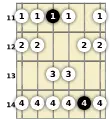
start by assigning your fingers to the first, second, third and fourth frets
on the fifth string play a D flat on the fourth fret using your fourth finger
on the fourth string play an E flat on the first fret using your first finger, an E on the second fret using your second finger and a G flat on the fourth fret using your fourth finger
on the third string play an A flat on the first fret using your first finger, an A on the second fret using your second finger and a B on the fourth fret using your fourth finger
on the second string play a D flat on the second fret using your second finger
In music theory, the minor scale is three scale patterns – the natural minor scale (or Aeolian mode), the harmonic minor scale, and the melodic minor scale (ascending or descending) – rather than just two as with the major scale, which also has a harmonic form but lacks a melodic form.
In each of these scales, the first, third, and fifth scale degrees form a minor triad (rather than a major triad, as in a major scale). In some contexts, minor scale is used to refer to any heptatonic scale with this property.